No More Meatballs: Rethinking How We Prune Our Plants
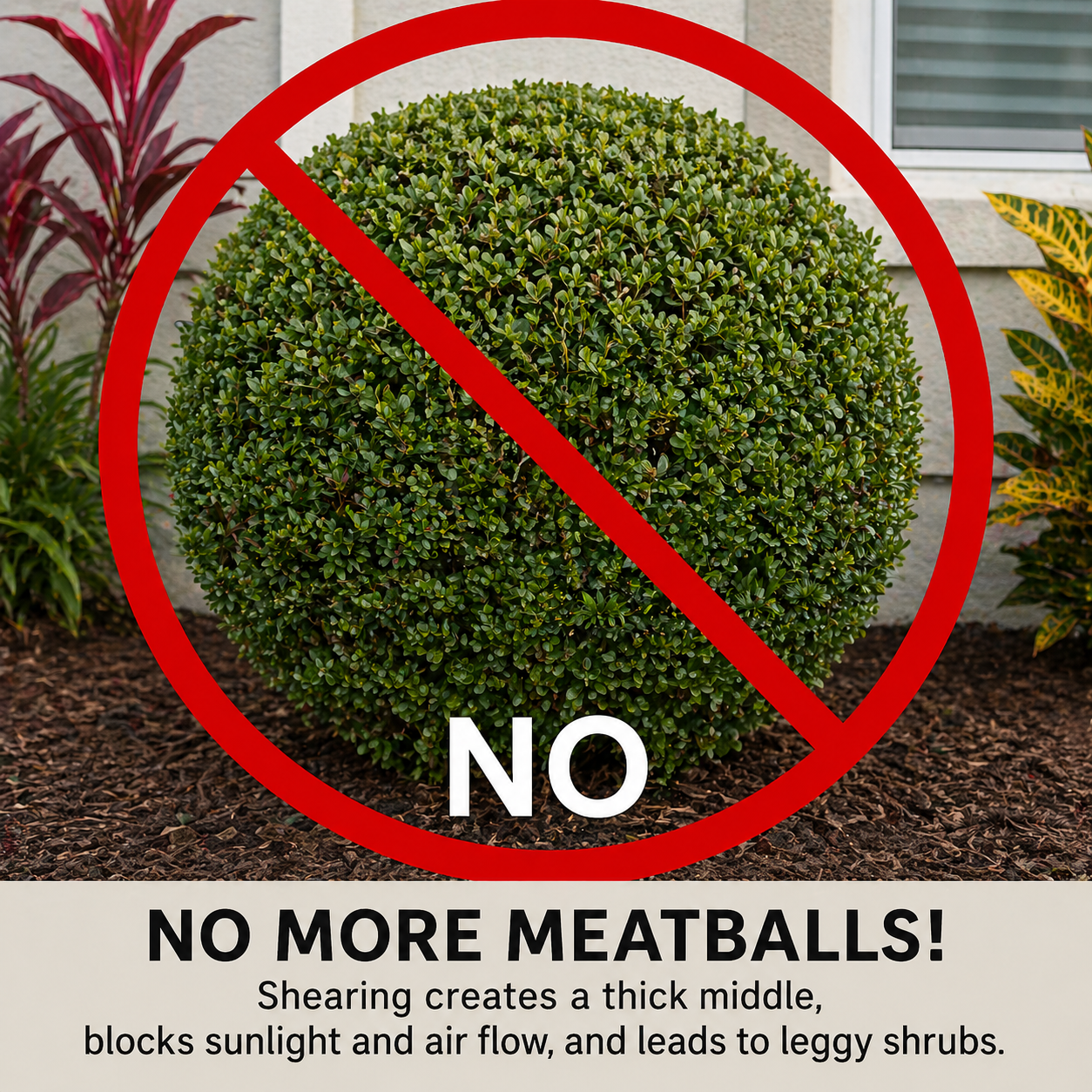
There’s a look that has become so common in Florida landscapes that most people don’t even question it anymore—rows of tightly clipped shrubs shaped into perfect balls, squares, or what I like to call “meatloafs.” Clean, uniform, controlled. On the surface, it feels tidy and intentional.
But this style of pruning, repeated over time, is one of the biggest reasons I see struggling, leggy, and unhealthy shrubs.
And it usually starts with good intentions.
Homeowners and maintenance crews alike want to keep plants neat. So the natural instinct is to grab the hedge trimmers and shear everything back. Just a little off the top, a little off the sides, clean up the edges. It’s quick, it’s efficient, and at first, it looks great.
The problem is that when this becomes the only method of pruning, it begins to change the plant in ways most people don’t realize.
Each time a plant is sheared, it responds by pushing out new growth at the tips. That growth gets cut again the next time, which causes even more growth at the outer edges. Over time, this creates a dense outer shell—a thick layer of foliage that looks full from the outside but hides what’s happening within.
Because inside, the plant is slowly declining.
That dense outer layer blocks sunlight from reaching the interior. Airflow becomes limited. Without light and air, the inner branches begin to weaken, lose leaves, and eventually die back. What’s left is a woody, sparse center surrounded by a green exterior.
From the outside, everything still looks fine—until the day you try to cut it back.
That’s when the problem reveals itself. Instead of a healthy, full plant, you’re left staring at bare sticks and empty space. The only place the plant has been able to produce growth is on the outermost layer, and once that’s removed, there’s nothing underneath to support it.
This is where those leggy, awkward shrubs come from. Not because the plant itself is flawed, but because it has been pruned in a way that worked against its natural growth pattern.
Plants are not meant to be solid, impenetrable shapes. They are living systems that rely on light filtering through their branches and air moving freely between them. When we repeatedly shear the exterior, we disrupt both of those things. And in Florida’s heat and humidity, that lack of airflow can quickly lead to increased pest pressure and disease issues.
Proper pruning looks very different.
Instead of focusing only on the outer shape, it requires a willingness to go deeper into the plant. To selectively remove branches, to thin where it’s too dense, and to open up the interior so that light and air can move through it. It’s a more thoughtful process, one that considers not just how the plant looks today, but how it will grow and function over time.
Pruning, at its core, is not about control—it’s about guidance.
It’s about shaping a plant in a way that still allows it to be what it naturally wants to be. It’s about removing what is dead, diseased, or crossing, and giving the plant the structure it needs to grow well. When done correctly, it doesn’t fight the plant’s form—it works with it.
And that often means letting go of the idea that everything needs to be perfectly symmetrical or tightly contained.
A plant that is allowed to grow more naturally will almost always be healthier. It will have better structure, fuller interior growth, and require less constant maintenance. It won’t need to be cut back over and over just to keep it in bounds, because it was never forced into an unnatural shape to begin with.
There is also a certain softness, a sense of ease, that comes from landscapes where plants are not over-controlled. They feel more alive, less rigid. The design still holds together, but it breathes.
That doesn’t mean there’s no place for shaping. There absolutely is. But shaping should enhance a plant, not suffocate it.
In the end, one of the most important shifts we can make is in how we define a “well-maintained” landscape. It’s not about how tight the edges are or how perfectly round every shrub looks. It’s about health. It’s about longevity. It’s about creating conditions where plants can thrive, not just survive.
So the next time you find yourself reaching for the hedge trimmers, it might be worth pausing for a moment and looking a little closer. Not just at the outside of the plant, but at what’s happening within it.
Because a plant that looks good on the surface isn’t always a plant that’s doing well.
And sometimes, the best thing we can do is put down the trimmers, step back, and let the plant breathe.