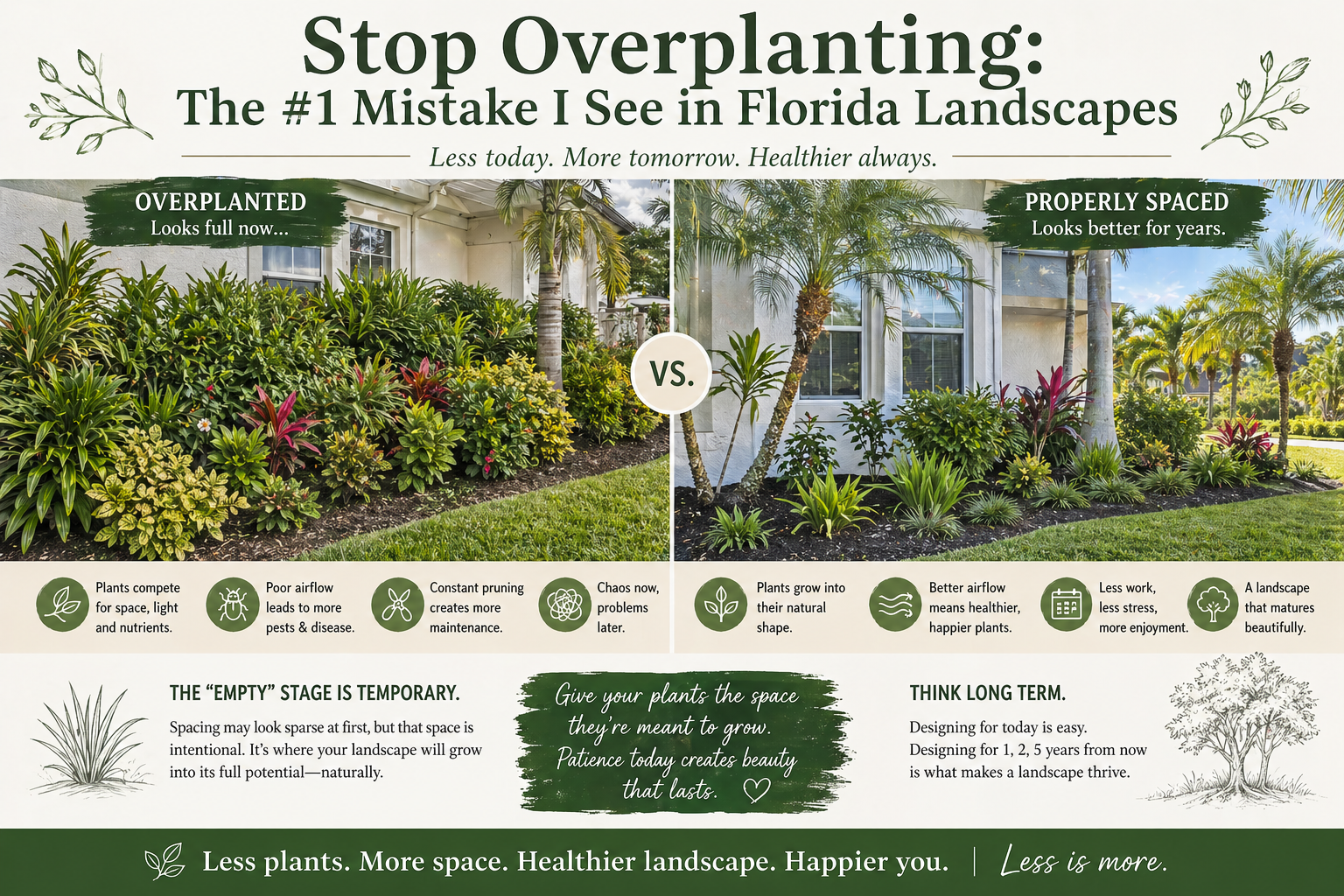
Stop Overplanting: The #1 Mistake I See in Florida Landscapes
If there’s one thing I wish more homeowners understood about landscaping in Florida, it’s this: we plant too much.
I see it over and over again. A new landscape is installed, and instead of appreciating the clean lines and intentional spacing, the first reaction is discomfort. It doesn’t look “full” enough. There’s too much visible mulch. The plants feel small, spaced out, almost unfinished. And after investing time and money, that feeling can be unsettling.
So the instinct is to fix it.
A few extra plants get added here and there. Then a few more. Before long, every gap is filled. The landscape looks lush, abundant, and complete. There’s an immediate sense of satisfaction.
But that satisfaction is short-lived.
Florida is not a place where plants grow slowly and politely. Given the heat, humidity, and long growing season, plants take off—often faster than people expect. What once looked balanced quickly becomes crowded. Branches begin to overlap. Plants compete for light and space. What was once a thoughtful design starts to feel chaotic and overgrown.
And that’s when the real problems begin.
Overcrowding limits airflow, which is one of the most important factors in keeping plants healthy in our climate. Without it, moisture lingers, and that creates the perfect environment for pests and disease. Suddenly, the landscape that was meant to feel easy and enjoyable becomes something that requires constant attention. Pruning becomes routine. Plants need to be cut back again and again just to keep them from overtaking one another.
What started as an attempt to make the space feel more complete ends up creating more work, more stress, and often more disappointment.
At the heart of the issue is a misunderstanding of how plants are meant to grow. When a plant tag says it will reach five feet wide, that’s not a suggestion—it’s a promise. That plant is going to take up space. And when it’s only given two or three feet to grow, something has to give. Either the plant is constantly cut back to stay within an artificial boundary, or it pushes into its neighbors, creating a crowded and unhealthy environment.
Neither outcome is ideal.
A well-designed landscape requires restraint, and restraint can feel uncomfortable at first. Proper spacing often looks sparse in the beginning. It can feel like something is missing. But that space is not empty—it’s intentional. It’s where growth will happen. It’s where plants will expand into their natural forms and create fullness over time, rather than being forced into it from the start.
This is one of the reasons I consider myself a conservative designer. I plant less, not because I want the landscape to feel minimal, but because I understand what it will become. My goal is not to create something that looks perfect on day one. My goal is to create something that looks better with time.
That requires thinking beyond the initial installation. It requires imagining what the space will look like in a year, or two years, when everything has had the chance to grow into itself. When plants are given the room they need, they develop more naturally. They maintain better structure. They are healthier, more resilient, and require less intervention.
And perhaps most importantly, the landscape begins to feel effortless.
There’s a calmness that comes from a well-spaced design. Repetition becomes more noticeable. The eye can move through the space without interruption. Instead of feeling crowded or busy, the landscape feels intentional and cohesive.
But getting there requires patience.
It means accepting that a new landscape may not deliver instant fullness. It means trusting that what feels unfinished today is actually in progress. And it means resisting the urge to fill every gap simply because it’s there.
In many ways, overplanting is driven by a desire for immediate results. We want to skip ahead to the finished version. But landscapes don’t work that way. They are living systems, constantly changing and evolving. Trying to rush that process often leads to more problems than it solves.
If there’s a shift I encourage homeowners to make, it’s this: stop asking how to make a landscape look full right now, and start asking how it will function over time.
Because a landscape that is designed with growth in mind will always outperform one that is designed for instant impact.
Overplanting is an easy mistake to make, especially when you’re eager to see results. But it’s also one of the most avoidable. With a little patience and a willingness to trust the process, you can create a space that not only looks beautiful, but stays that way.
And in the end, that’s what really matters.