When Your Soil Fails You
One of the most common things I say when designing Florida landscapes is this:
Florida’s sandy soil usually isn’t the problem.
In fact, for Florida-friendly and native plants, our natural sandy soil is often exactly what they want. It drains well, warms quickly, and supports plants that have evolved to thrive in lean, fast-draining conditions. When native soil is left intact, many landscapes perform beautifully with minimal intervention.
But increasingly, I’m seeing landscapes where plants struggle, decline, or completely fail — even when the “right plants” are being used.
And the issue isn’t the plants.
It’s the soil beneath them.
The Hidden Problem in New Developments
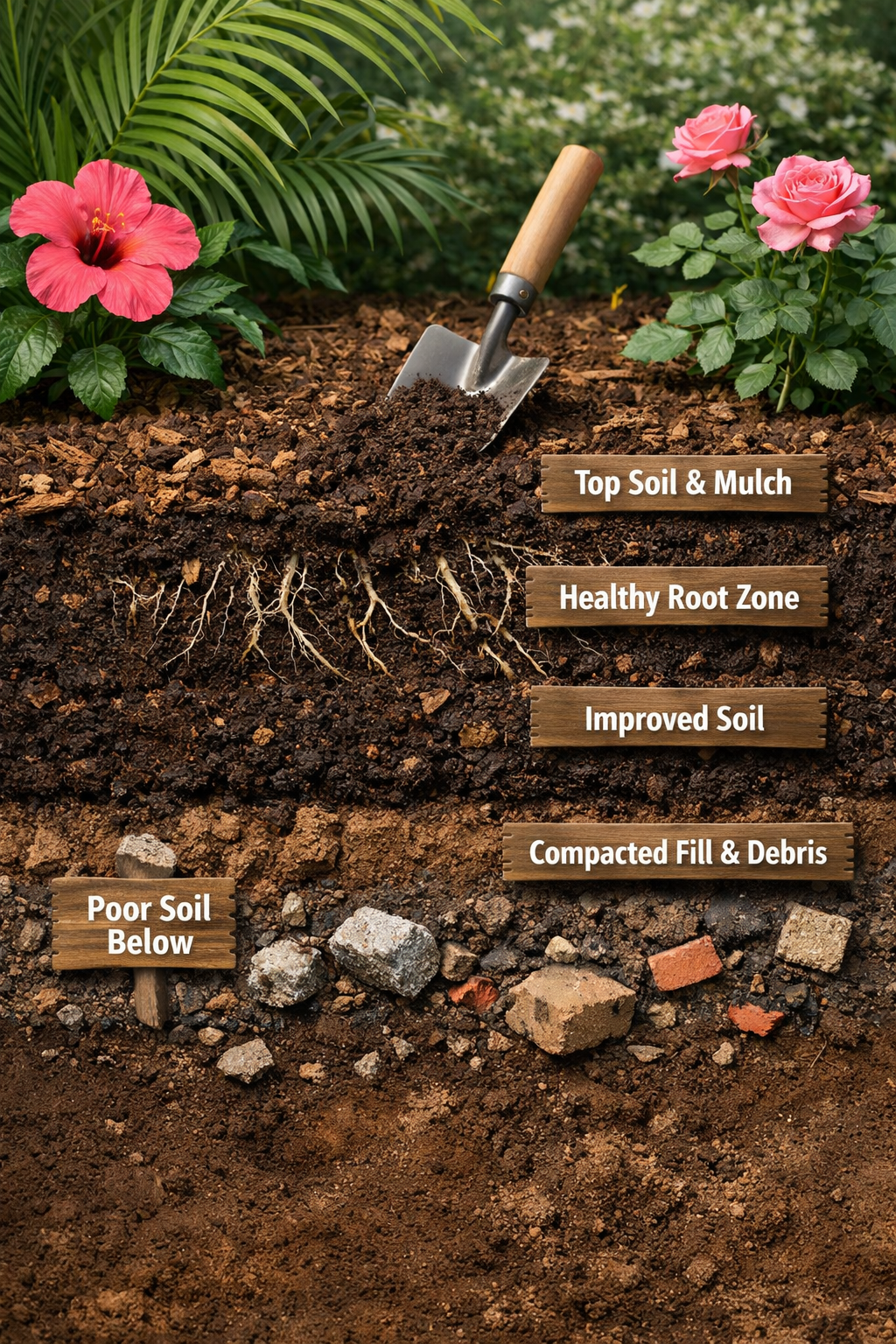
In many newer communities across Florida, the original native soil has been removed or heavily disturbed during construction. What replaces it is often fill dirt — and that term can mean almost anything.
I’ve dug into planting beds and found:
Construction debris
Concrete chunks
Concrete dust
Compacted clay-like fill
Buried trash
Subsoil scraped from other sites
This material may look acceptable from the surface, especially once sod and mulch are installed. But underneath, it behaves nothing like Florida’s natural sandy soil.
Instead of draining properly, it holds water. It becomes dense, sticky, and oxygen-poor. Roots sit in moisture instead of breathing, and plants slowly decline despite proper watering and care.
Homeowners often assume they are doing something wrong.
But sometimes, the soil has simply failed them.
Learning the Hard Way
I learned this lesson early while working in a newer development where plants I had used successfully for years began failing one after another.
These were tried-and-true Florida performers — plants that normally thrive with very little fuss. Yet they struggled. Leaves yellowed. Growth stalled. Root systems declined.
When I finally dug deeper, the problem became obvious.
The soil underneath was wet, heavy, and mucky — almost swamp-like despite normal irrigation. Water wasn’t moving through the soil profile at all. Roots were essentially sitting in unusable ground.
No plant, native or otherwise, can succeed without oxygen at the root zone.
That experience permanently changed how I approach planting in new construction landscapes.
How I Help Repair Failed Soil
You can’t always remove poor fill soil entirely, but you can begin rebuilding healthy soil over time.
My approach focuses on building upward rather than digging deeper.
Instead of fighting the existing soil, I work to improve the planting environment layer by layer.
Step One: Build Organic Matter
Organic material is the long-term solution.
Each year, I add:
Quality topsoil
Organic mulch
Compost-rich materials
Repeated annually, these layers slowly improve structure, drainage, and microbial life. Over time, nature begins correcting what construction disrupted.
Healthy soil is not created in one season — it’s rebuilt gradually.
Step Two: Plant Into Better Soil, Not Just Existing Soil
When installing plants, I typically:
Apply topsoil on top of existing mulch or soil to begin raising the planting grade.
Dig planting holes wider than necessary.
Backfill holes partially or fully with quality topsoil depending on plant needs.
This creates a transitional zone where roots can establish successfully before eventually growing into surrounding soil.
The goal is to give plants a strong foundation from day one.
Step Three: Extra Support for Heavy Feeders
Certain plants benefit from additional soil improvement at planting time.
Plants such as:
Palms
Roses
Hibiscus
often respond well to the addition of high-quality potting mix blended into the planting area. This provides improved aeration, organic matter, and nutrient retention during early establishment.
Used thoughtfully, this creates stability without trapping excess moisture.
How to Know If Your Soil Needs Help
A formal soil test can absolutely be helpful, especially for nutrient analysis.
But sometimes the simplest test is observational.
Dig several inches into your planting area and look closely.
Ask yourself:
Is the soil staying wet long after watering or rain?
Does it feel sticky or dense instead of sandy?
Does water pool or drain slowly?
Does the soil smell sour or stagnant?
If soil remains wet below the surface, roots are likely struggling for oxygen — and amendment or elevation is needed.
The Foundation Matters Most
We often focus heavily on plant selection — choosing natives, Florida-friendly species, or drought-tolerant options — and those choices absolutely matter.
But even the best plant cannot overcome poor soil conditions.
When soil fails, plants fail.
By gradually building organic layers, improving planting zones, and giving roots a healthier starting environment, landscapes begin to recover. Growth improves. Maintenance decreases. Plants establish the way they were meant to.
Good gardening in Florida isn’t always about adding fertilizer or watering more.
Sometimes it’s about recognizing that what lies beneath the surface needs rebuilding first.
Because every successful landscape starts with something we rarely see — a strong, living foundation underground. 🌿