What Your Landscape Is Missing: The Power of a Focal Point
If you’ve ever stood in your yard and felt like something just isn’t quite right — even though everything is healthy and growing — you’re not alone.
The plants may be thriving. The lawn may be maintained. Flowers might even be blooming. And yet the landscape feels unfinished, slightly chaotic, or lacking impact.
In many cases, the problem isn’t plant selection or maintenance.
It’s the absence of a focal point.
One of the most common design mistakes I see in Florida landscapes is the tendency to add more plants when something feels missing. Homeowners visit the garden center, fall in love with beautiful specimens, and bring them home hoping the space will finally come together. But without intention, those plants become a collection rather than a composition.
A well-designed landscape needs somewhere for the eye to rest — a visual anchor that quietly organizes everything around it.
That anchor is your focal point.
What Is a Focal Point?
A focal point is simply the element that naturally draws your attention first. It gives the landscape structure and direction. Instead of your eye wandering aimlessly across competing plants, it lands somewhere purposeful before moving comfortably through the rest of the garden.
Think of it as the difference between walking into a thoughtfully furnished room versus one filled with random furniture placements. Both may contain beautiful pieces, but only one feels calm and cohesive.
Landscapes work the same way.
In Florida especially, where plants grow quickly and lushly, gardens can become visually busy very fast. Without structure, everything competes for attention. A focal point restores balance and creates order without requiring more maintenance or complexity.
Letting Plants Create Structure
Some of the most effective focal points are living ones.
A single well-placed tree or palm can define an entire landscape. A Sabal palm (Sabal palmetto), Florida’s native state tree, instantly creates a sense of place while supporting wildlife and tolerating our climate extremes. A striking Bismarck palm (Bismarckia nobilis) introduces bold color and architectural form. Native small trees such as Simpson’s stopper (Myrcianthes fragrans) provide refinement while offering food and shelter for birds and pollinators.
These plants do more than fill space — they establish permanence. They signal intention.
Even large shrubs can serve this role beautifully. A sculpted cocoplum (Chrysobalanus icaco), a thriving firebush (Hamelia patens), or a naturalized grouping of Walter’s viburnum (Viburnum obovatum) creates mass and presence that anchors surrounding plantings. Suddenly, smaller perennials and groundcovers have context. The garden begins to feel designed rather than assembled.
Focal Points Don’t Have to Be Planted
Not every focal point needs roots in the ground.
One of the most underused design tools in Florida landscapes is the strategic use of large containers. Oversized pots placed at an entryway, along a walkway, or framing a porch create instant structure and elevate the entire space. Filled with Florida-friendly plants such as muhly grass (Muhlenbergia capillaris), coontie (Zamia integrifolia), or a dwarf native shrub, containers provide height and emphasis without permanent installation.
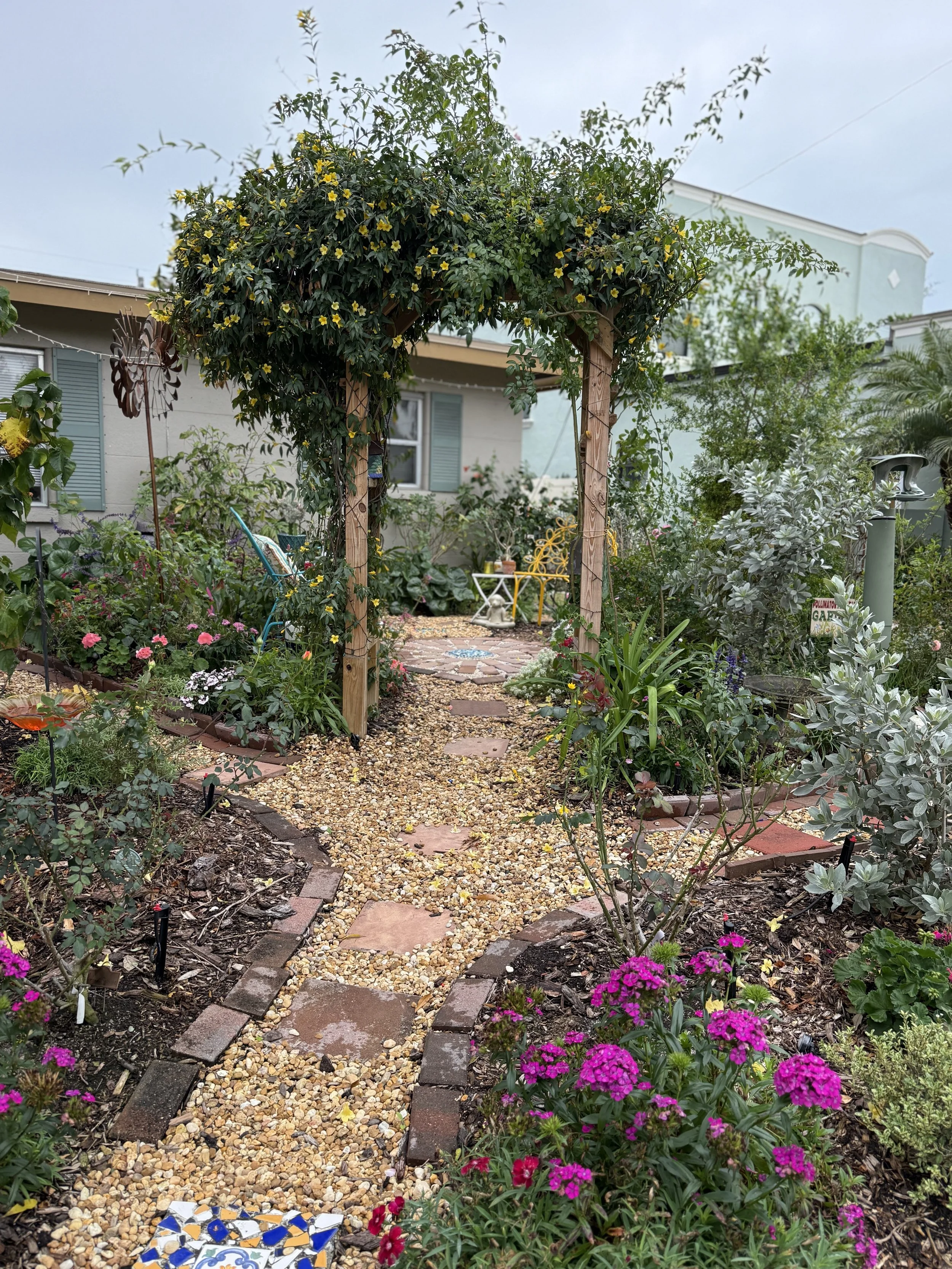
Garden structures can serve a similar purpose. An arbor marking a transition between spaces, an obelisk rising from a planting bed, or a trellis supporting a flowering native vine introduces vertical interest that many flat landscapes lack. When paired with pollinator-friendly climbers like coral honeysuckle (Lonicera sempervirens) or passionflower (Passiflora incarnata), these features become both architectural and ecological assets.
They guide movement through the garden while adding year-round visual strength.
More Than One Focal Point
Interestingly, the most successful landscapes rarely rely on just one focal feature.
Professional designers often create a sequence of focal moments — an inviting element near the entry, another drawing you deeper into the yard, and perhaps a final destination in the backyard. This layering encourages exploration and creates a sense of journey rather than a single static view.
Your eye moves naturally from one point of interest to another, and the landscape feels larger, calmer, and more intentional.
When a Landscape Lacks Direction
If your yard feels flat, cluttered, or perpetually unfinished, it may be missing hierarchy rather than plants. When everything is the same height or visual weight, nothing stands out. The result is subtle discomfort — the sense that something should look better but doesn’t.
Adding one strong focal point often transforms the entire space without increasing maintenance. In fact, it frequently allows you to simplify plantings and reduce excess.
Designing With Purpose
Florida-friendly and native landscapes thrive when we work with structure first and plants second. By choosing climate-adapted trees, substantial shrubs, containers, or garden structures as anchors, we create gardens that are not only beautiful but sustainable and easier to maintain.
Sometimes the difference between an average yard and a truly memorable one isn’t more color or more variety.
It’s intention.
A single palm placed exactly where it belongs.
A sculptural native shrub commanding attention.
An arbor welcoming you into the garden.
When your landscape has something meaningful to focus on, everything else finally makes sense. 🌿