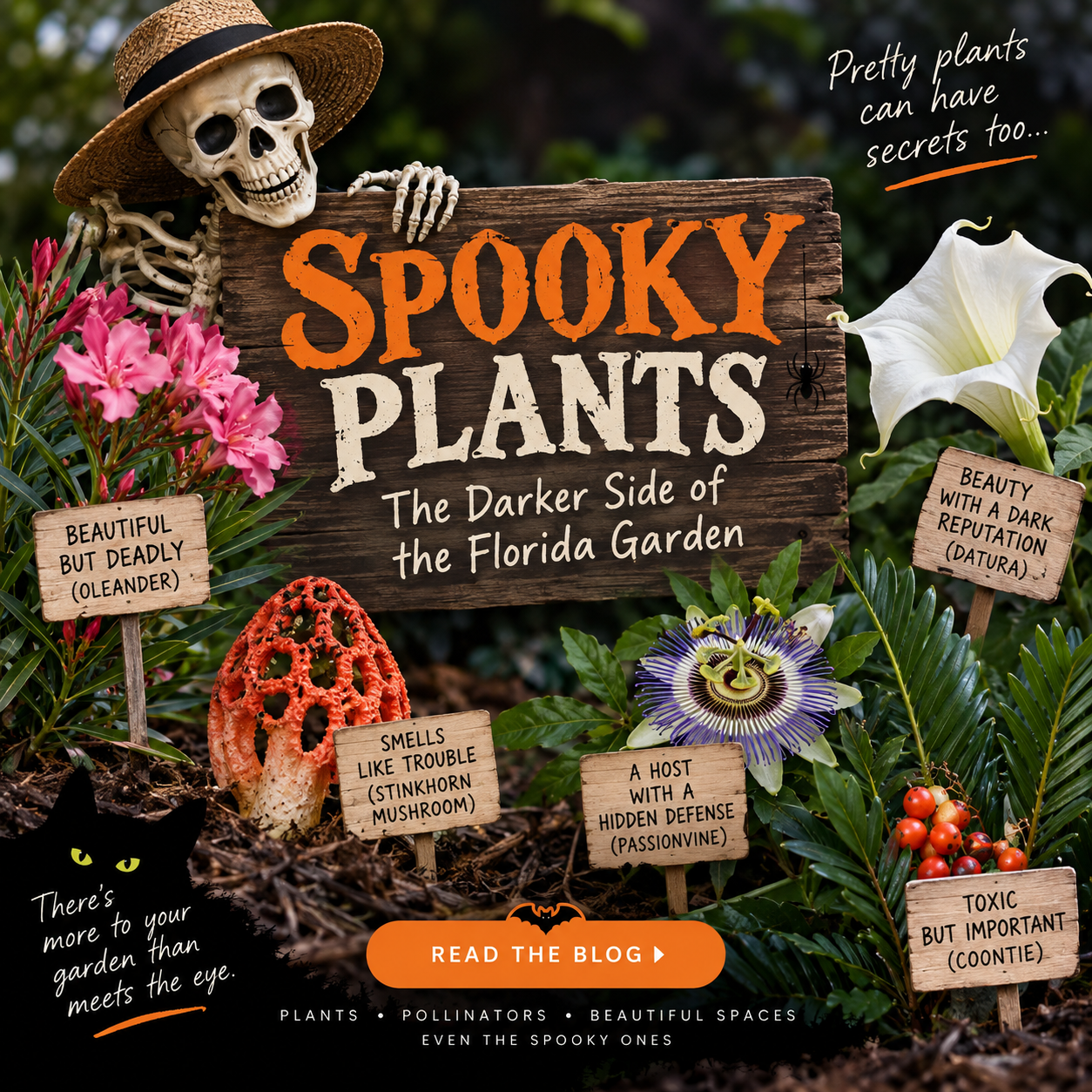
Spooky Plants: The Darker Side of the Florida Garden
October is the perfect time to talk about the slightly darker side of gardening. Because while our landscapes may look peaceful and beautiful, some of the plants growing around us have secrets.
Some are poisonous. Some have developed impressive ways to defend themselves. Others lure insects with smells we'd probably rather not experience ourselves. And a few have histories and folklore that make them seem right at home in a Halloween garden.
So in honor of spooky season, here are a few plants with a darker side that you might encounter in—or even grow in—a Florida landscape.
Oleander: Beautiful but Deadly
Oleander (Nerium oleander) is one of those plants that can look almost too pretty to be dangerous. It's an evergreen shrub with beautiful clusters of pink, white, red, or salmon-colored flowers, and its tolerance for heat, drought, and coastal conditions has made it a familiar landscape plant in Florida.
But all parts of oleander are toxic if ingested. The plant contains cardiac glycosides that can affect the heart, making this one plant that deserves respect. Even though simply having oleander in the landscape isn't the same thing as being poisoned by it, it's important to know what you're growing—especially in spaces where children or pets may have access to plants.
It's a great reminder that "beautiful" and "harmless" aren't always the same thing in the plant world.
Coontie: Toxic Plant, Important Butterfly
This one may surprise people because coontie (Zamia integrifolia) is one of my favorite Florida native landscape plants. It's incredibly useful in our landscapes and happens to be the host plant for one of our most beautiful native butterflies, the Atala.
But coontie is also toxic if eaten. Its seeds and other plant tissues contain compounds that can be harmful to people and animals.
Here's where nature gets really interesting: Atala caterpillars can feed on coontie despite its toxicity. They sequester some of those defensive compounds, which helps make both the caterpillars and adult butterflies unappealing to predators. Their striking red, black, and orange coloration isn't just beautiful—it serves as a warning.
A toxic plant helping protect a butterfly? That's the kind of spooky garden story I love.
Datura: The Beautiful Trumpet With a Dark Reputation
Datura (Datura spp.) looks like something you'd expect to find growing outside a witch's cottage. Its large trumpet-shaped flowers can be absolutely gorgeous, often opening in the evening, but the plant has a long history associated with poison, medicine, ritual, and folklore.
All parts of Datura contain potent tropane alkaloids and can be extremely toxic if ingested. This isn't a plant to experiment with or use medicinally on your own.
Its dramatic flowers and nighttime presence have helped give it common names such as devil's trumpet, which feels particularly appropriate for an October garden.
Stinkhorn Mushrooms: Something Smells Dead
If you've ever walked outside and wondered what died in your garden—only to discover a bizarre red, orange, or strangely shaped mushroom—you may have met a stinkhorn.
Stinkhorn fungi have one of the stranger reproductive strategies in the garden. Rather than relying primarily on wind to distribute their spores, many produce a foul-smelling, sticky spore mass that attracts flies and other insects. The insects land on it, pick up spores, and help carry them elsewhere.
Basically, the fungus smells terrible on purpose.
And some stinkhorns look just as strange as they smell. Depending on the species, they can appear as columns, lattices, tentacle-like structures, or other shapes that look like they belong in a science-fiction movie rather than your mulch.
The good news? Stinkhorns are generally decomposers breaking down organic material. They're weird, smelly—and actually part of what's happening naturally beneath our feet.
Passionvine: Beautiful Flowers With a Hidden Defense
Passionvine (Passiflora spp.) may not look spooky, but there is some fascinating chemistry happening behind those beautiful flowers.
Many passionvines contain defensive compounds that discourage animals from eating them. Yet Gulf fritillary and zebra longwing caterpillars have evolved to use passionvines as host plants.
It's another example of the ongoing evolutionary battle between plants and the insects that eat them. Plants develop defenses. Insects develop ways around those defenses. Then the plants develop new strategies.
Your butterfly garden may look peaceful, but there's an entire survival story playing out on those leaves.
Plants Aren't as Defenseless as They Look
We tend to think of plants as passive. They grow where they're planted, soak up the sunshine, flower, and look pretty.
But plants have been defending themselves for millions of years.
Some produce toxins. Others have thorns, spines, irritating sap, tough leaves, strong scents, or bitter-tasting compounds. Some have developed relationships with insects and animals, while others use surprisingly creative strategies to attract the creatures they need for pollination or seed dispersal.
And that's part of what makes gardening so fascinating to me. Once you start learning what's actually happening in the landscape, you realize there's much more going on than what we see from the garden bench.
So this October, take another look around your garden. That beautiful flower, strange mushroom, butterfly host plant, or thorny shrub might have a much more interesting—and perhaps slightly spooky—story than you realized.
Because sometimes the most beautiful plants in the garden have a darker side.