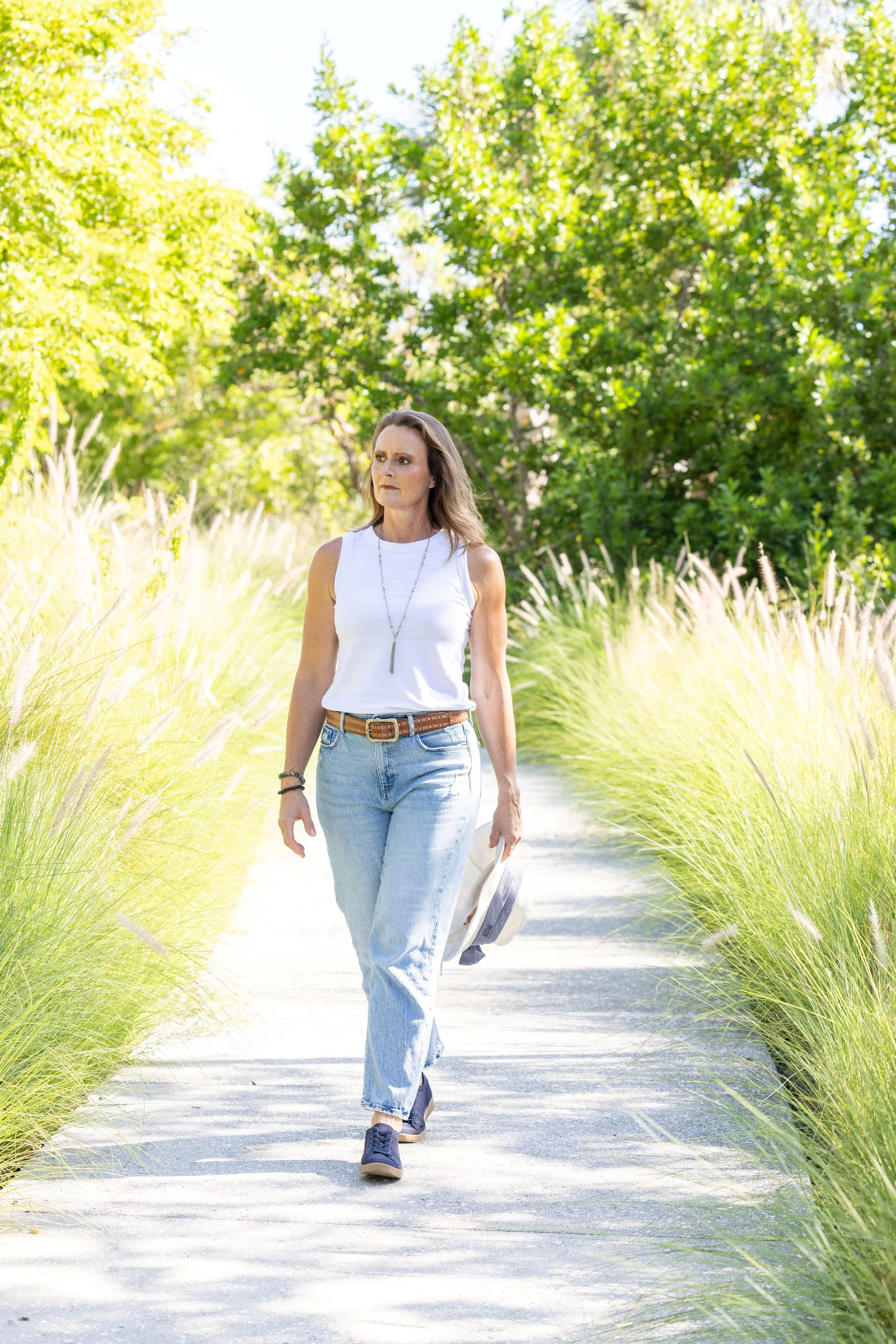
Plant More Grasses: One of the Best Things You Can Do for Your Florida Landscape
If there's one group of plants I think is underused in Florida landscapes, it's grasses.
We tend to think first about flowers, shrubs, and trees when planning a landscape, but grasses can completely change the way a garden looks and feels. They add movement, texture, softness, repetition, and wildlife value—and they can work in just about any landscape style.
I've found myself using more and more grasses in my own garden and in the landscapes I design because they do something flowers can't always do: they make the entire design better without demanding all the attention.
Grasses Add Movement to the Landscape
Most of our landscape plants are fairly static. Shrubs sit where we plant them. Groundcovers create a carpet. Trees provide the canopy. Grasses bring something completely different: movement.
Even the slightest breeze moves through their foliage and seed heads, which makes a landscape feel alive. That movement is especially beautiful when grasses are planted in groups rather than as individual specimens scattered throughout a bed.
There's something about watching muhly grass sway in the breeze that instantly softens a landscape.
They Create Texture Without Adding More Flowers
I'm a flower person. Obviously. But one of the biggest changes I've made in the way I design is realizing that not every interesting plant needs to flower.
A landscape filled with flowers can actually start to feel busy. Grasses give you another way to create interest through fine foliage, upright forms, arching blades, and seed heads. They contrast beautifully with broad-leaved shrubs, rounded forms, tropical foliage, and lower-growing groundcovers.
That contrast is what makes individual plants stand out.
Instead of adding another flowering perennial because a bed feels like it's missing something, sometimes what it really needs is a completely different texture.
Grasses Work With Almost Every Garden Style
One of my favorite things about grasses is how versatile they are.
In a more formal or HOA-friendly landscape, repeating grasses in intentional groupings can create a very clean, polished look. In a naturalistic or pollinator garden, they help soften the design and create that layered, meadow-like feeling. They can also work beautifully in modern landscapes, tropical gardens, cottage gardens, coastal landscapes, and around patios or pools.
It's all about which grass you choose and how you use it.
A few grasses randomly scattered throughout a bed will create a very different feeling than a mass planting or a repeated grouping used to carry your eye through the landscape.
They're One of My Favorite Plants for Repetition
If you've followed me for any amount of time, you've probably heard me talk about repetition.
Repetition is one of the simplest ways to make a landscape feel intentional instead of looking like a collection of plants. And grasses make repetition incredibly easy.
You can repeat the same grass in several areas of a large bed, use it on both sides of a walkway, tuck groups between shrubs, or carry it from one landscape bed to another. That repeated shape and texture helps visually connect everything.
And because grasses aren't usually screaming for attention, you can repeat them generously without making the landscape feel overwhelming.
They Soften All the Hard Stuff
Florida landscapes have a lot of hard edges—driveways, sidewalks, pool decks, lanais, walls, fences, and landscape borders.
Grasses are one of my favorite ways to soften them.
Their loose, flowing form creates a beautiful contrast against hard surfaces and rigid architecture. They can soften the corner of a house, break up a long row of shrubs, make a pathway feel more natural, or add movement alongside a pool deck.
This is one of those small design choices that can make a landscape feel much more established and inviting.
Grasses Can Provide Important Wildlife Habitat
The value of grasses goes far beyond how they look.
Depending on the species, grasses can provide cover, nesting material, seeds, and habitat for insects and other small wildlife. Dense clumps can create protected spaces close to the ground, while seed heads may provide food.
They also add another layer to a pollinator-friendly landscape. Creating habitat isn't only about planting nectar flowers. A healthy garden has layers—trees, shrubs, flowers, grasses, and groundcovers all doing different jobs.
That's one reason I love incorporating grasses into pollinator landscapes. They help us move away from thinking that supporting wildlife simply means planting more flowers.
They Can Make a Landscape Feel Full Without Feeling Crowded
This is a big one for me.
There's a difference between a landscape looking lush and a landscape looking crowded.
Grasses can fill visual space without adding the heaviness of another large shrub. Their fine texture allows you to see through and around them, and their movement keeps the landscape feeling light.
They're especially helpful when you're trying to create layers. A group of grasses can transition beautifully between larger shrubs and lower groundcovers or flowers without making every inch of the bed feel packed.
Some of My Favorite Grasses for Florida Landscapes
We have so many great grasses and grass-like plants that work beautifully in Florida landscapes. Some are native and offer additional wildlife value, while others are useful for bringing texture and contrast into the design.
Florida natives: Muhly grass (Muhlenbergia capillaris) is probably the one I use most often for its fine texture and beautiful pink fall blooms. Elliott’s lovegrass (Eragrostis elliottii) has soft blue-green foliage and delicate seed heads, while purple lovegrass (Eragrostis spectabilis) brings an airy purple haze when in bloom. Fakahatchee grass (Tripsacum dactyloides) and dwarf Fakahatchee (Tripsacum floridanum) are great for stronger structure and larger masses. Sand cordgrass (Spartina bakeri) is another tough option for larger spaces. Juncus, or rush, is technically a rush rather than a true grass, but its upright foliage is especially useful in wetter areas.
For non-native, grass-like options, variegated liriope can add a bright, fine-textured border, while mondo grass (Ophiopogon japonicus) is useful as a lower-growing groundcover, particularly in shadier areas.
You don't need to use ten different grasses in one landscape. Choose a few that fit your conditions and repeat them throughout the design. That's where grasses really shine—they quietly connect everything around them while adding movement, texture, and structure.
Your Landscape Might Not Need Another Flower
If you're looking at your landscape and something feels like it's missing, your first instinct might be to add more color.
Before you buy another flowering plant, consider adding a grass instead.
Maybe the bed needs movement. Maybe it needs a finer texture to contrast with all those shrubs. Maybe you need repetition to connect different areas. Maybe a hard edge needs softening. Or maybe your pollinator garden needs another layer of habitat beyond flowers.
Grasses aren't always the plants that grab your attention first at the nursery—but they may be some of the plants that make the biggest difference once they're in your landscape.
Plant more grasses. Your landscape—and the wildlife using it—will thank you.