Living in Florida, we get pretty spoiled when it comes to gardening. Our long growing season means there is almost always something blooming, and it's easy to start thinking that a beautiful Florida landscape should be covered in flowers all year long.
But it doesn't need to be. And honestly, it shouldn't have to be.
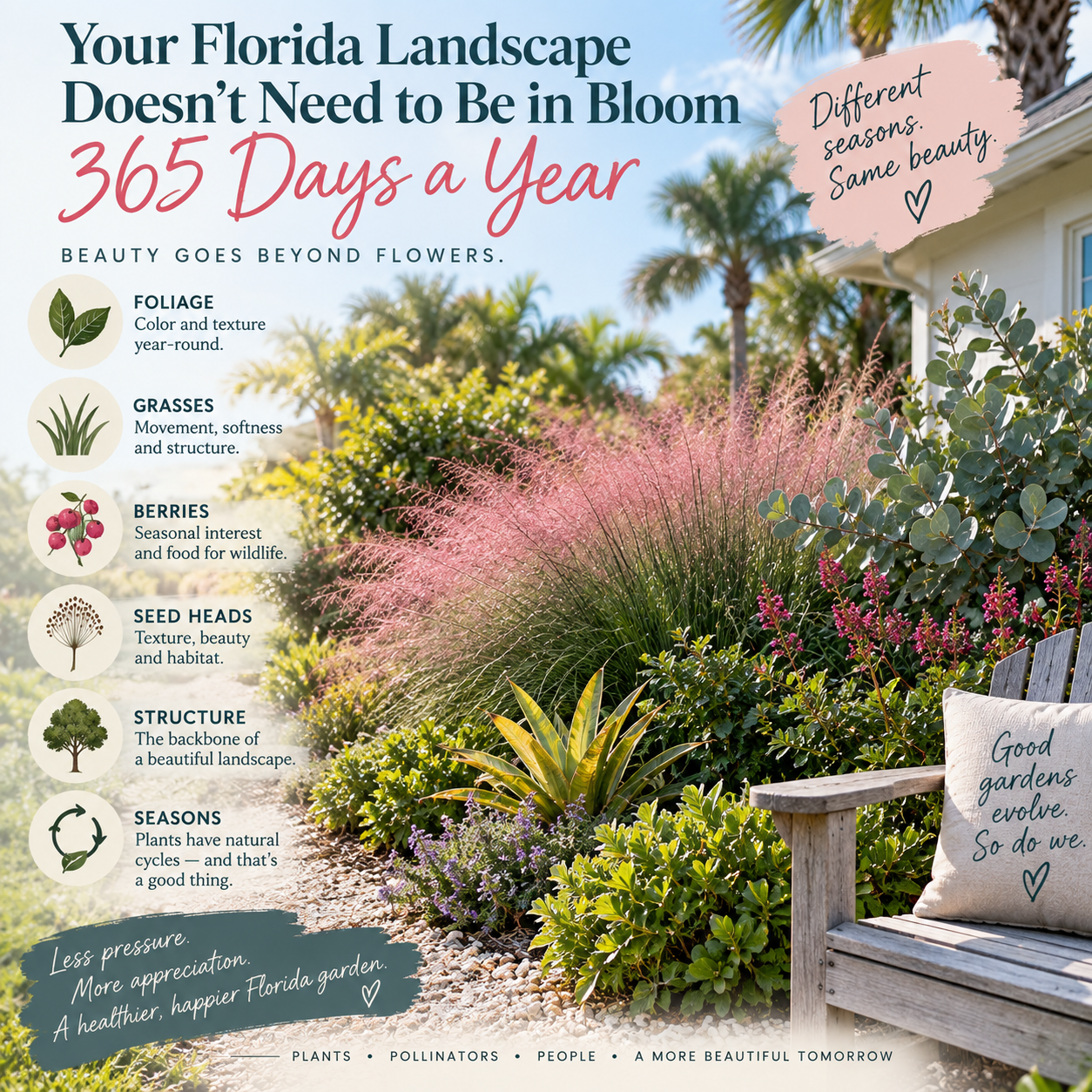
One of the biggest shifts I've made in my own garden and in the way I think about landscape design is relying less on constant flowers and more on foliage, texture, grasses, groundcovers, berries, structure, and seasonal interest. Flowers are wonderful—I will always have them—but they don't have to carry the entire landscape.
Flowers Are Supposed to Come and Go
Plants have natural cycles. They bloom, rest, put on new growth, produce seeds or berries, and bloom again. Even plants known for flowering for long periods aren't necessarily going to look exactly the same twelve months of the year.
And that's okay.
We've somehow gotten the idea that if a flowering plant isn't flowering, something must be wrong with it. Sometimes it's simply doing what plants do.
Instead of expecting every part of the landscape to be colorful all the time, I think there's something really beautiful about allowing the garden to change throughout the year. It gives you something to look forward to.
When the muhly grass starts turning pink in fall, it's special because it doesn't look like that all year.
Foliage Can Carry a Landscape
This is something I've come to appreciate more and more.
When you're choosing a plant, don't just ask what its flowers look like. Ask yourself, “What does this plant look like when it isn't blooming?”
Interesting foliage can provide color and texture every single day. Silver foliage can brighten a bed. Deep greens can create a beautiful backdrop. Variegated leaves can add contrast. Large tropical leaves paired with fine-textured grasses can create just as much visual interest as a bed full of flowers.
When the foliage is beautiful, you don't have to depend on blooms to make the landscape interesting.
Grasses Give You Something Flowers Can't
I've become a huge fan of using more grasses in landscapes for exactly this reason. They bring movement, texture, softness, and structure without needing to be covered in flowers.
Even when muhly grass isn't putting on its incredible pink fall show, its fine green foliage still contributes to the design. Other grasses add wispy seed heads, interesting shapes, and movement when the wind blows through them.
They also create a beautiful contrast against broader-leaved shrubs and groundcovers. Sometimes the thing your landscape is missing isn't another color—it's another texture.
Berries and Seed Heads Count as Garden Interest Too
Flowers aren't the only thing worth looking at.
Some shrubs and small trees produce berries or fruit that add seasonal color while also providing food for birds and other wildlife. Seed heads can bring texture and movement to the garden and, depending on the plant, may also provide food or habitat.
We can be a little too quick to cut everything back the minute a flower fades. Sometimes leaving the plant alone for a while allows it to move into its next interesting stage.
A pollinator-friendly landscape isn't only about providing nectar flowers. Creating habitat means thinking about the whole life cycle of the garden and the different ways plants can support wildlife.
Structure Is What Holds Everything Together
This is probably the most important part.
If your landscape only looks good when everything is blooming, the problem may not be a lack of flowers. It may be a lack of structure.
Trees, shrubs, grasses, palms, groundcovers, and plants with strong forms create the bones of a landscape. They establish height, layers, repetition, and focal points. They're what make the landscape feel designed even during quieter periods.
Flowers should be layered into that structure—not expected to create it.
It's the same reason I'm planting fewer flowers in my own garden than I used to. I want the landscape to feel beautiful and intentional whether I have fifty things blooming or five.
Let Your Garden Have Seasons
Florida seasons may not look like seasons in other parts of the country, but we absolutely have them in the garden.
Different plants bloom at different times. Grasses change. Berries appear. Some plants slow down. Others suddenly take off when the weather cools. Summer rains create one kind of garden, while our drier months create another.
I think we miss part of the joy of gardening when we're constantly trying to make everything look exactly the same.
A garden isn't a photograph. It's supposed to change.
Those changes also make certain moments more meaningful. The first flowers on a favorite plant, the arrival of pink muhly plumes, berries forming on a shrub, new growth appearing after a quiet period—those things are exciting because they aren't there every day.
You Might Actually Need Fewer Flowers
If you find yourself constantly buying flowering plants because your landscape feels boring whenever something stops blooming, take another look before heading to the nursery.
Maybe what you're missing isn't another flower.
Maybe you need a small tree to add height. A group of grasses for movement. A beautiful evergreen shrub for structure. A groundcover to connect the bed. A plant with interesting foliage. Or simply more repetition so the landscape feels cohesive.
Ironically, using fewer flowers can sometimes make the flowers you do have feel more special. Instead of every plant competing for attention, a sweep of color becomes a focal point against quieter foliage and structure.
I still want flowers in my garden. I still want butterflies, bees, and hummingbirds visiting them. But I no longer think every square foot needs to be blooming for my garden to be beautiful.
Give your landscape good bones. Plant for texture, foliage, movement, wildlife, and seasonal interest. Then let the flowers come and go.
Your Florida landscape doesn't need to perform 365 days a year. Give it permission to have seasons—and you may find that you appreciate it even more when it blooms.